Data Science & Analysis · 2024
Towards a Sustainable City Policy for Managing Shared Dockless E-Scooters
Background
Shared dockless e-scooter operators have a structural incentive to cluster their fleets in dense, high-demand city centers — leaving peripheral neighborhoods chronically underserved. This paper, published in Procedia Computer Science (ABMTRANS 2024), investigates whether that mismatch is measurable in Tel Aviv and proposes a data-driven policy to correct it.
The study draws on an anonymized dataset of one million shared scooter rides collected by the Tel Aviv municipality via POPULUS across 22 working days in March 2023 — covering roughly 7,500 vehicles operated by 5 companies across the city's 52 km². A complementary dataset of 730,000 application activations from one operator captures what happens when a user opens the app but does not end up riding.
Methodology
- Combined supply-side data from all five Tel Aviv operators into a single trip-level dataset via the MDS / POPULUS feed.
- Used average parking duration per zone as a demand proxy: a scooter that is picked up quickly signals high latent demand; one left idle for many hours signals oversupply.
- Aggregated metrics to Traffic Analysis Zones (TAZ) to map supply–demand balance across the city at the neighbourhood scale.
- Analysed 730K application activation records to measure the ride/no-ride decision — specifically, how proximity to the nearest available scooter determines whether users proceed with a trip.
Results
Figure 2 — Demand heterogeneity across the city
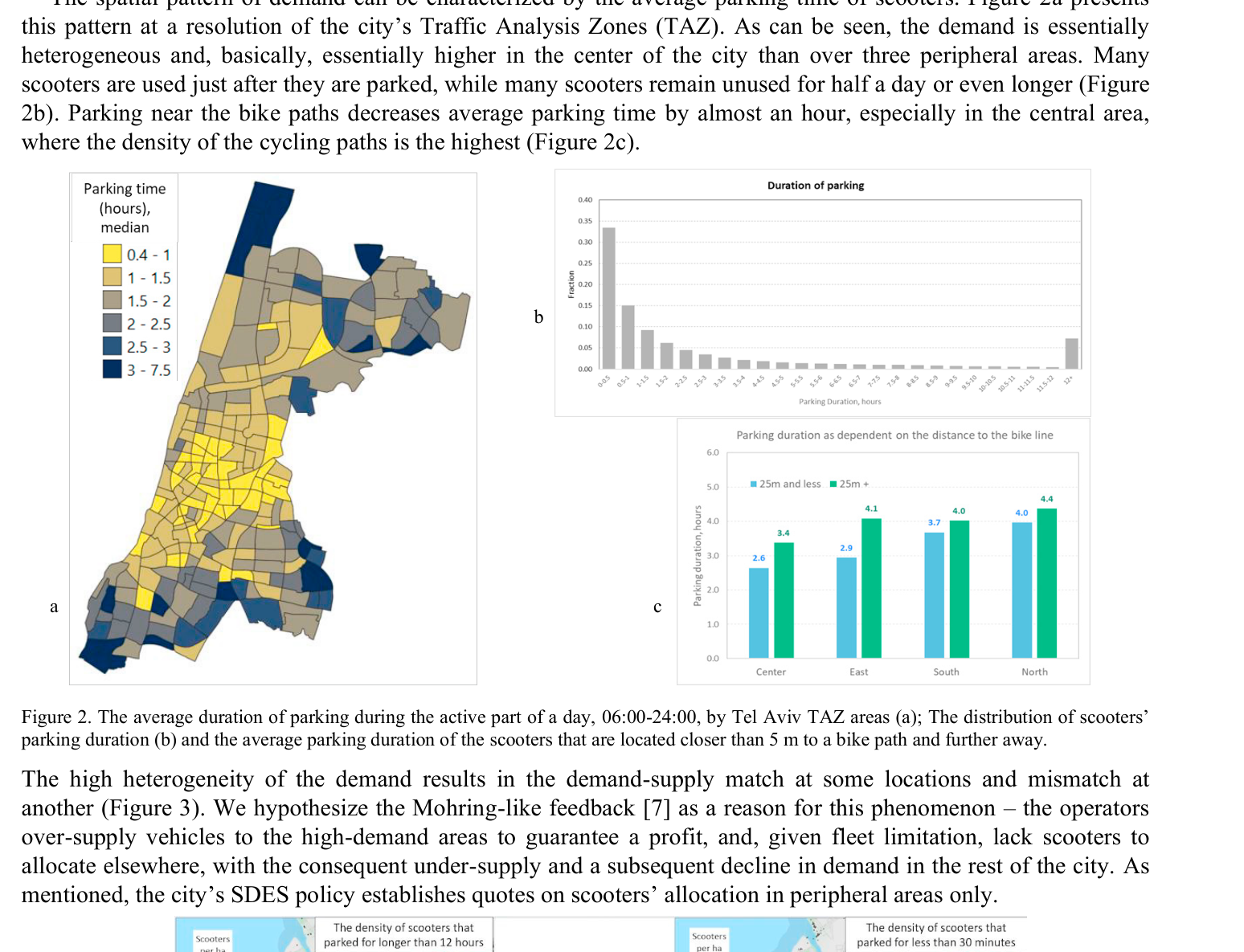
Figure 2. Average parking duration by TAZ (a) reveals that demand is concentrated in the center and falls sharply toward the periphery. Panel (b) shows many scooters sitting idle for 6–12+ hours — a strong oversupply signal. Panel (c) shows proximity to a bike path cuts idle time by almost an hour, especially in the center where cycling infrastructure is densest.
Figure 3 — Where supply exceeds demand, and where it falls short
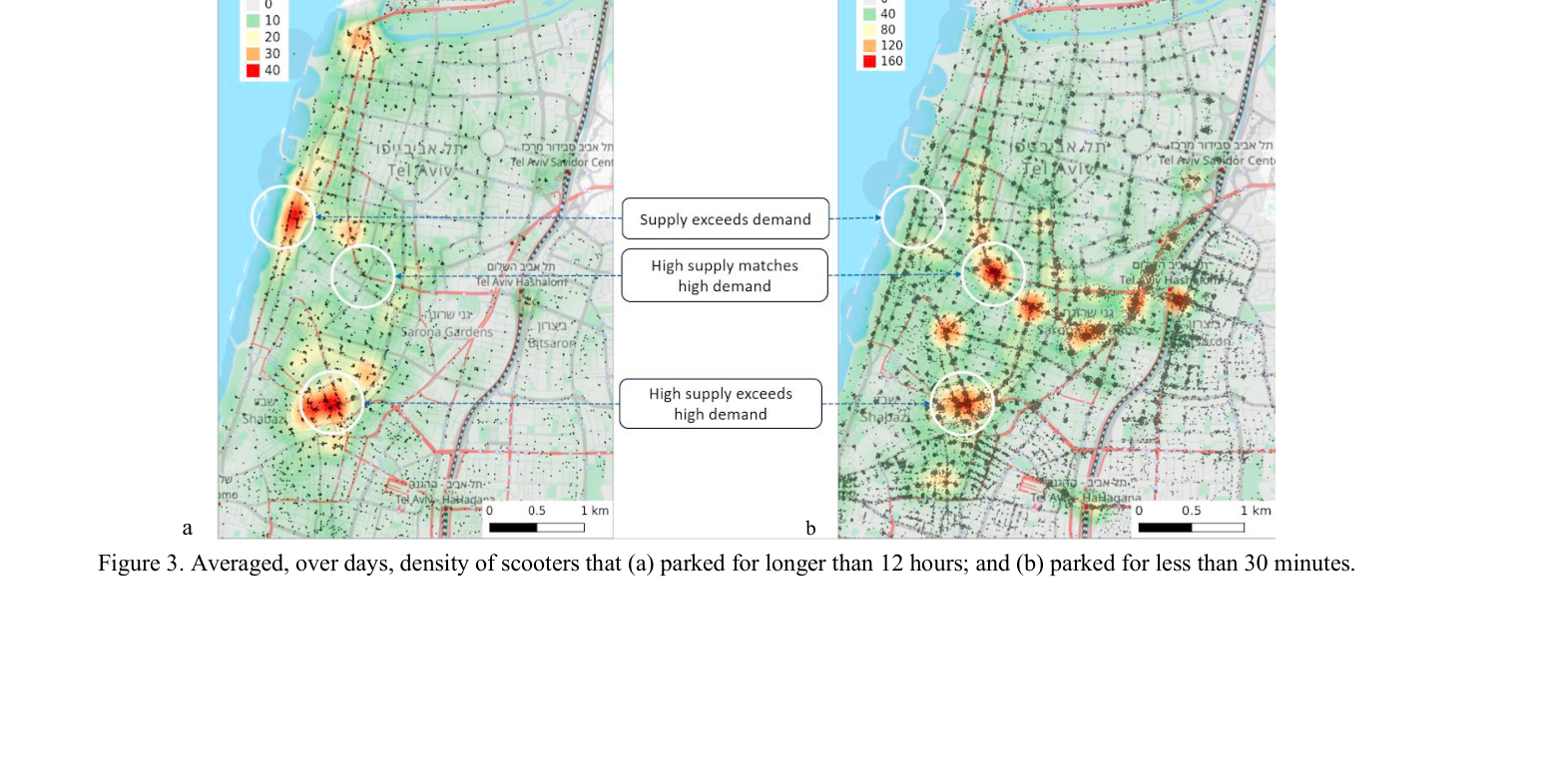
Figure 3. Scooters idle for more than 12 hours (a) pile up in the central tourist and commercial zones — clear oversupply. Scooters turned over within 30 minutes (b) are more dispersed but absent from large peripheral stretches, where demand exists but is starved of supply. We attribute this pattern to a Mohring-like feedback: operators concentrate in the center to guarantee profit, which erodes demand at the periphery through chronic unavailability.
Figure 6 — The ride/no-ride decision and its spatial footprint
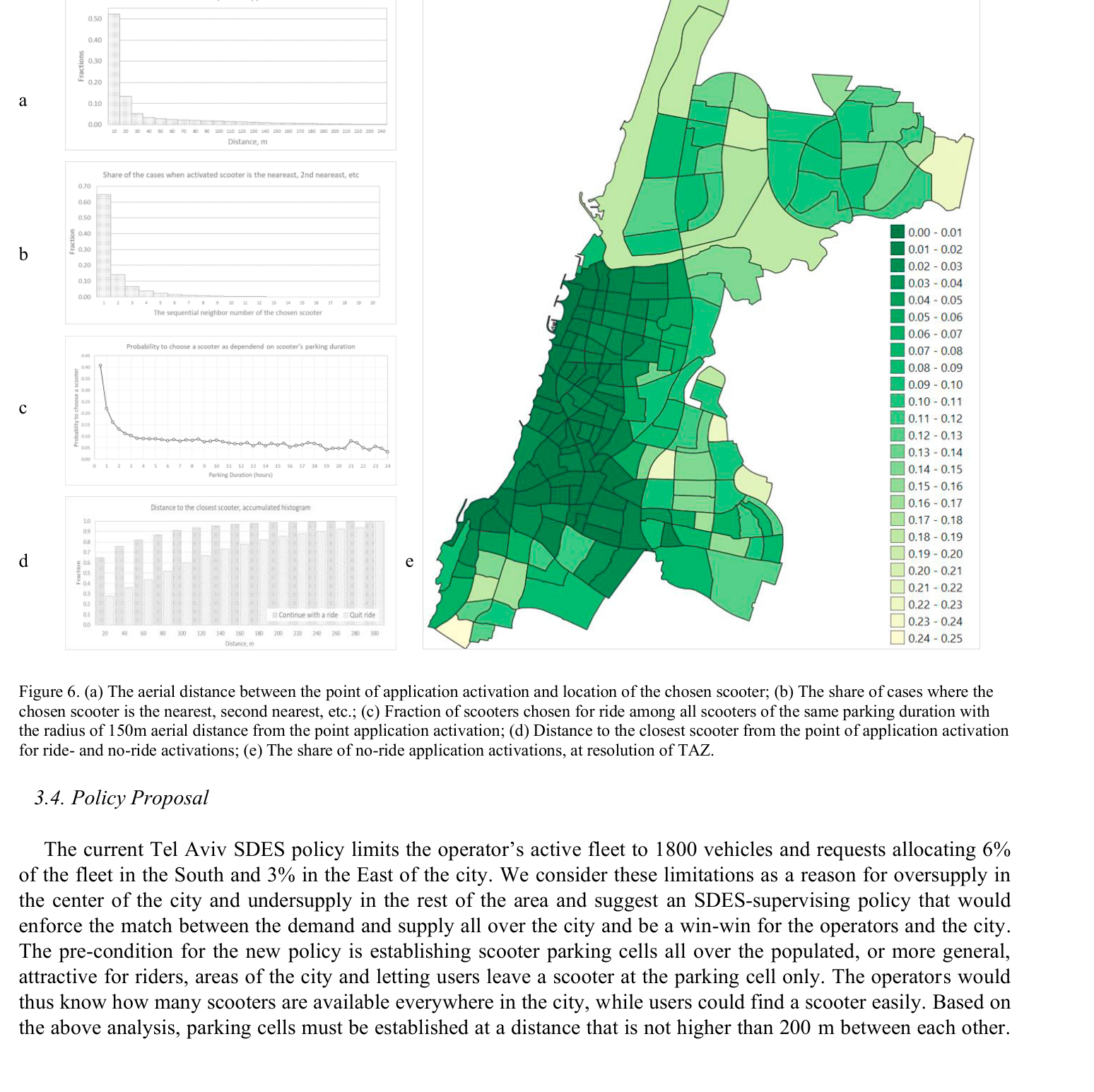
Figure 6. The ride decision is highly proximity-driven: 95% of riders choose a scooter within 110 m (a), 75% take the closest one (b), and older-parked scooters are progressively less likely to be chosen (c). When no scooter is within 100 m, more than 30% of activations end without a ride (d). Spatially, this no-ride rate is virtually zero in the Tel Aviv center but climbs to 15–25% on the periphery (e) — the direct consequence of the supply deficit documented in Figure 3.
Based on this analysis, the paper proposes a citywide policy built on two mechanisms: establishing parking cells across all populated areas at no more than 200 m spacing, and requiring operators to relocate scooters idle for 8–12+ hours from oversupplied cells to undersupplied ones. The policy turns oversupply into a directly observable, actionable signal rather than relying on blunt percentage quotas for peripheral districts.
Publication
Published in Procedia Computer Science, vol. 238, pp. 722–727, as part of the 13th International Workshop on Agent-based Mobility, Traffic and Transportation Models (ABMTRANS 2024), Hasselt, Belgium.
View paper on ScienceDirect → Download PDF